Showing posts with label islington mill. Show all posts

Monday, 16 November 2015

Ladyfest MCR @ Islington Mill 14.11.15


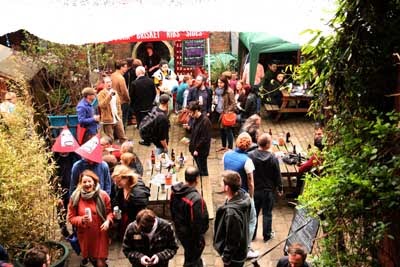
Last weekend saw this year’s big Ladyfest event take place at Islington Mill.  Ladyfest has been on my radar for several months  and, from what I gleaned from social media, would be a bold, informative and creative event.

Ladyfest isn’t unique to Manchester; similar festivals take place in other UK cities, and a quick Google shows festivals happening across the pond.  The common ideology is to showcase work by women and others who might experience barriers to sharing their work, from trans, non-binary and intersex artists or mothers juggling childcare, offering a supportive environment away from the generally competitive nature of the creative industries, where money and contacts can be everything.  However, Ladyfest Manchester aims to give visibility to Manchester-based creatives in particular, evidenced in the line-up of musicians and comedy performers sourced from an open call-out.


Workshops on offer included Sex Workers’ Rights, Bike Maintenance and Screen Printing.  I attended a workshop entitled The Art Of Consent, billed as ‘exploring body language, verbal communication, gender stereotyping, 'grey areas' and barriers, laws, and the value of challenging our sexual assumptions in an interactive, creative setting’ - which seemed a huge task for an hour long session.  I went on my own, feeling a little vulnerable and awkward sitting alone at a table, whilst the other table was occupied by a group of friends.  Thankfully, I was soon joined by others who had rejected the remaining empty table - unlike most other everyday situations - with another solo woman joining us minutes later.  And this was indicative of the whole workshop: friendly and open in an atmosphere where it felt ok to share.  There was no pressure, no expectation.  The workshop’s leader Chelsea Murphy - a local consent and sexual violence researcher - and her facilitators were clear that we need only talk about things with which we we felt comfortable.  We discussed and we got our thoughts and feelings down creatively through working together on a collage.  I left feeling positive, not because we’d changed the world or come up with definitive solutions - how can you with such a difficult, provocative subject? - but because I’d been in a room with people who wanted to address the subject of consent and those who wanted to support that discussion.

Of course, that particular workshop isn’t going to be everyone’s cup of tea, but the sense I got was that it was indicative of the whole day.  Speaking to Carly Lyes, one of the event’s organisers, it’s clear how central the idea of community and being supportive is to Ladyfest.  Everyone there, whether organising, running a workshop, running a stall or performing, was a volunteer.  Ladyfest Manchester is self-funded and self-organised, the only money coming in from ticket sales.  People are involved because they want to be, because there is a need for this kind of event and community and because the inclusivity it aims to create seems to be successful - the event sold out well in advance.  When asked about future events, Lyes is ready with the plans: a larger festival next year spread over a longer period of time and different venues, more participatory workshops and the possibility of branching out and having their own stage at the big festivals.  From my time there on Saturday, the Ladyfest Manchester clearly has a relevance, a community willing to put in the time and effort to make it happen and an audience who want to participate.

Words: Julie Burrow

Sunday, 24 May 2015

Review: I’ll Be Your Mirror by Una Baines & Keith McDougall

The pat response to hearing about a new graphic novel about The Fall frontman Mark E Smith would be to say that it shouldn't be too hard to do – he's already a cartoon. Decades of self-mythologising, abetted by journalists happy to colour the outline in familiar shades: a face squiggled with lines and a fag hanging out of the gob, gnomic pronouncements and scathing put-downs, drink and drugs and rows.


It's gratifying, then, that the new graphic memoir I'll Be Your Mirror, drawn by Keith McDougall and co-written with Una Baines, a founding member of The Fall, presents a young, relatively fresh-faced Smith, one not yet hemmed in by his own mythology.

Baines also played in Manchester bands Blue Orchids and Poppycock, as well as touring with Nico, but the first issue of the memoir focuses on how she met Smith as a teenager. It's 1973, but the book avoids grim-up-north clichés as adroitly as it dodges the typical narrative about The Fall. McDougall's illustrations reflect the overall tone, which is teenager-bubbly – Bowie, T. Rex, feminist marches and psychedelia.

Smith puts Baines onto the Velvets as she outgrows glam rock, she puts him onto women's rights, they drop LSD and, finally, they start a band. Or rather, Mark does. In signature style, by hijacking her neighbour's covers group and launching into an impromptu performance of ‘Sweet Jane’. The final image shows him centre stage, lips curled, flanked by two bewildered musicians, person and persona already beginning to merge.


Hopefully there'll be some more about Baines herself in later editions, which will tell the story of her relationship with Mark, but there's more than enough here to pique the interest, and not only for fans of The Fall. Manchester looks set to be a major supporting character throughout, hopefully avoiding its usual thankless role of moody backdrop.

The launch is taking place at Islington Mill on 29 May, featuring Una's band Poppycock with support from ILL and Rose & The Diamond Hand.

Words: Fearghus Roulston

Tuesday, 28 April 2015

Preview: Sounds From The Other City 2015, Sunday 3rd May

The May Day Bank Holiday is approaching this weekend and that can only mean one thing. Well, depending which century your traditions are originate, it might mean a few other things, from pagan dancing to International Workers’ Day, but for Chapel Street in Salford it can only mean one thing, and that’s Sounds From The Other City festival.


The annual new bands knees up is once again the highlight of the long weekend, commandeering the Sunday by booking in some of Greater Manchester's finest pop pickers. This year, those directing proceedings hop from the buzz band heavyweights at Now Wave to seasoned niche indie selectors at Bad Uncle and Comfortable on a Tightrope, via the pathway of dependable promoters at Hey! Manchester, Grey Lantern and Fat Out, round the record label corner to Gizeh/Little Red Rabbit, Red Deer, Sways, Samarbeta and Tru Luv, and back onto the main road blockaded by visual delights at Video Jam and the comic timing of Sham Bodie. And breathe.

Under those umbrellas, or rather in those venues, you’ll find many of those currently orbiting at the centre of Manchester’s creative universe rubbing shoulders with handpicked touring acts to set your ears ablaze. Ex Easter Island Head’s collab with the BBC Philharmonic Ensemble is sure to be a standout, and you won’t go far wrong with Naked (On Drugs), Paddy Steer, Liz Green, Jane Weaver, Black Josh, Acre Tarn or many more, but roaming around is always a sure fire way to see something unexpectedly great.

Venues-wise, meet at the Islington Mill wristband exchange from 3pm and float whichever way the musical breeze blows you.

Words: Ian Pennington

For tickets and more info: soundsfromtheothercity.com

Thursday, 8 May 2014

Sounds From the Other City 2014, Path Two


Double digits. SFTOC is 10. A coming of age? Never mind the sentiment, is the event any good? Each year has seen a development, a willingness to tinker with an arrangement that keep it fresh and vibrant, judging by the number of people in attendance.

At Islington Mill, Yiiikes TV are unveiling their version of Blind Date, with guests hoping to unlock the secrets of someone else’s “treasure chest”.


Bands are appearing in a nearby brewery, and a marquee has been erected outside The New Oxford. It forms a dual role of being the place where short films are having a new soundtrack created by local artists, whilst also being a communal meeting point and hub to move around.

On the basis that you need to try something to see if it’s any good, acoustics within The First Chop Brewery come across very well, at least in the case of four-piece Babe, whose intriguing mix of David McAlmont style vocals, warm electronic beats and relaxed style tempt an unfamiliar crowd to move along nicely.


If we are to be invaded by aliens then the future is bright. Not orange, but silver and perhaps white, going under the names of the Volkov Commanders. They’re a friendly bunch, ever willing to help you around and create fun, celebrating the vibrancy of the first festival and still as valid.


If you had merely heard Thomas Long singing rather than witness the person live, then the cracked, rich, deep vocals could conjure up an image of a mature, ageing person reflecting on the hardships and experiences he’s endured. Needless to say, that image is nothing like the person sat down in the New Oxford. There is a connection with the past in his lyrics, an acknowledgement of other people’s struggles. Full of emotion and passion, he slips in a line that suddenly drags reality into view: “This set is dedicated to Steve Lloyd”. Gone but not forgotten.


The event is a satisfying mix of known local acts alongside the lesser known. This means that local favourites such the Young British Artists turn the Old Pint Pot from a near-empty venue to one that is rammed, whilst attendance for other, unfamiliar acts still have a decent turnout.


Audio-visual goings on at St Philip’s Church join a host of acts that you wish you could fit into a crammed itinerary, but there’s always next year. Roll on May 2015.

Words and photos: Ged Camera

Sounds From The Other City 2014, Path One


There are various ways of approaching Sounds From The Other City. First and foremost, as an open-minded musical explorer keen to turn your ear towards the innovative sounds on offer; some with, others without an airtight route plan for the day. You can also join the team of volunteers who will have the benefit of seeing many of the positive responses while also glancing at a small section of the hard work that goes into staging the event. Or be more proactive as a hands-on reveller taking part in the Volkov Commanders’ fancy dress theme of giant, colourful helmets.


Then there’s the perspective of the many musicians themselves, who’re often living round the corner from you in this city or the other city and just as keen as the rest of us to see their fellow sound merchants in action. For me, wearing a reviewing hat, there are too many highlights to see through one pair of eyes, so we’ll feature more reviews of the festival over the coming days.


The event has gradually migrated from its original location, based around the crossroads where Chapel Street meets Bloom Street and New Bailey Street, to now centre on the organisers’ arts grotto Islington Mill. It stretches from Uni of Salford venues Maxwell Hall and Peel Hall at one extreme to the fledgling brewery First Chop and Bexley Square at the other.


Having narrowly missed the excitement emanating from Islington Mill’s Gallery space during the Blind Date game show revisit (more on that later), Bexley Square is where my journey through the day began. Seasoned pros in the audio visual matchmaking game, Video Jam had again amassed a healthy mix of musicians and filmmakers, including Mike Halpin’s live sampling of bicycle sounds to accompany Cote D’Azur and the FX pedalling, eyeball helmeted trio who tampered with their own voices in scoring The Summoning, a film depicting the aforementioned Volkov Commanders in action. Later on, O/L/A’s beautifully nuanced live soundtrack of a section of Baraka was a fitting curtain closer for this gazebo stage.


Deli Lama’s stall offered vegan nourishment outside another of the festival’s venues, The New Oxford pub, where Easter guitarist Thomas Long performed a few songs from his band’s forthcoming album, capturing the breadth of Idlewilderness and trad folk in his emotive delivery. Later the Carefully Planned Festival favourite Tekla found herself performing from the same seat in intimate surrounds.


In an instance of film translated to real life, The Summoning by Volkov Commanders manifested itself as a parade from the Old Pint Pot which I’m told later snaked past St Philip’s Church and the Angel Centre, where Deep Hedonia’s AV sermons and Tru Luv’s dream pop hopefuls were staged respectively.

Inside the Pint Pot was the other end of the noise spectrum as Mistoa Poltsa’s 12-stringed audio anarchy blitzed through the rafters. On this stage Kult Country also unleashed layered soundscapes in the name of psychedelia.

Back at Islington Mill were the Grumbling Furs, who were a departure from Mind On Fire’s usual bookings, sounding as they did like 80s pop fed through stabbier soundscapes. Only their prolonged ambient waltzes diverted from visions of the last dance at a high school prom movie – perhaps following ‘Forever Young’ in Napoleon Dynamite.


In the gallery, the Blind Date matchmaking from earlier in the day heralded some indifferent results as two pairs recounted their days together. Then, on The Word variety show, the John Cooper Clarke influenced Thick Richard spat his venomous tales about bus seat MCs and hypothetical obituaries for Bez, before sack-wearing band Horrid answered questions. Other 90s TV shows rebooted for the occasion include Stars In Their Eyes and Family Fortunes, pitting contestants inside a giant TV box by virtue of some thinking that was decidedly outside the box and very at home in the world of SFTOC.


The First Chop Brewery made its SFTOC debut with aplomb. Many of its patrons went away more smiley than one of the venue’s featured acts, Happyness, whose conversely moody outlook was potentially prompted by their US college indie rock tinted specs. By the time its in-house band Karate 5 took to the stage, the brewery was left with only two ales on tap – down from nearly ten at the start of the day. Exclusive event ale TOC was one of those devoured.

Back with Karate 5, they were one of the highlights. In Denis Jones’s ‘Beginning’, perhaps his most widely known song and formerly a regular set-closer, he sings of a “super band where they all lend a hand”. In a sense Karate 5 is the realisation of this vision as he lines up alongside members of Honeyfeet, Walk and Cat In Paris to form a boogie jam band capable of instilling rhythm into even the weariest of jivers. Led by Rik Warren’s husky tones, their rendition of Ann Cole’s ‘Got My Mojo Working’ saw no foot remaining unmoved under the arches.


Back at Islington Mill, Pete Herbert and later the El Diablo DJs were stepping up the groove that Werkha and 2 Billion Beats had earlier set in motion. The rest is a joyous daze.

Words: Ian Pennington
Photos: Ged Camera

Early bird tickets are now available for next year’s event here.

Saturday, 21 December 2013

Glenn Jones @ Islington Mill, Salford, 15.11.13

If you want to talk all that talk about due-paying, then Cul De Sac have been experimenting since the 70s and are a kind of indie Grateful Dead because of that. Glenn Jones has done time, inside Cul De Sac and out. He sat at the feet of John Fahey and worked with him, somewhat frustratingly. Fahey also did serious time, and played Manchester before he died, in lovely red football socks, shorts and a Harold Shipman beard. The 'tunes' matched the dress connotations. Fahey's last tour was conducted by ex-psychiatric worker Paul Kelly and apparently ended in some appropriately RD Laing / Felix Guattari-style 'therapy'.


Fahey's most beautiful records had a dark undercurrent, which seduced and dragged you down into the clay mud with the sediment of a thousand years of struggle, pain and beauty. They're exhumations, what Herr Hegel described as 'sublation' – all previous epochs dragged forth in the now – this is what happened in Fahey's music. The then-recent import of eastern raga added to country blues, ragtime, jazz and all other American musics. Fahey could destroy entire civilisations with the casual opening twang of an open low e-string, before picking among its smoking ruins for bright artefacts to make the rest of the album with.


The support act, Directorsound, is essentially Nicholas Palmer, a man now signed to Domino, who presented some interesting passages of music. Palmer is on the way to something interesting, but his journey there is all over the place – formally and literally – his one man band approach didn't have an organising principle. The kind of Paris busker accordion he played had heavy connotations, in Eastern European, war-torn landscapes for instance, and that he tried to interrupt them was intriguing, but the interruptions were throwaway, none of it was properly worked out, or couched in any kind of conscious strategy: Directorsound is a few steps away yet.


Jones treads traditional water, thus this is Takoma records karaoke to an extent. He recalls such great Fahey albums as The Dance of Death and Other Plantation Favourites and Days Have Gone By, but what he does tonight is what Fahey always did: pull some really heavy histories back through the strings of a simple acoustic guitar or banjo.

Jones talks between songs engagingly, about Jack Rose of Pelt, about Meg Baird of Espers and how Bruce Springsteen irritates him. But this is not the main event. When Jones plays, he provides a map to the past, rich in detail, a necessary guide for anyone packing a rucksack, intending to move along that road, back to the future. Directorsound's Nicholas Palmer could take a lesson from what Jones does with American music, before applying it to his own practice. There is a way to play that means when you bend the strings, you bend space and time.

Words & photos: Steve Hanson.

Friday, 20 April 2012

Interview: Veí

Jonn Dean has been a constantly shifting musical experimenter during his time recording and performing music from a Manchester hub. An electronica project took the backseat while he played keyboards with local alt-rock group Kin, but since they disbanded Veí has moved to the fore.

The name itself is curious enough without introduction to the open-minded approach to musical composition lying beyond. Even the name ‘Veí’ has evolved during its lifespan, as Dean explains. “I started working on my own material whilst I was still playing keys for Kin, but I was quite keen to start writing with someone else rather than it remain a solo project. I worked on a few tracks initially with Paul Mckie (formerly of From the Kites of San Quentin) and I was trying to think of a suitable name for the collaboration. As we lived opposite one another at the time I thought it would be interesting to see whether the word 'neighbours' had a quirky ring to it when translated into another language. The Catalan word for neighbours is 'Veïns' which I loved instantly and we stuck with that.”

He continues: “When Paul became busier with Kites and wasn't available to continue with the project, I was curious to know what the singular of Veïns would be, so Veí was born. The notions of producing electronic music and writing and performing under a pseudonym have always felt synonymous to me, especially given my influences, and I enjoy the association with the actual meaning of the word – everyone is someone's neighbour.”

His tracks have been included on compilations and a debut digital EP, Thank You For Talking, was supported by forward-thinking music collective Mind On Fire. It could be said that recorded music is all about capturing a moment to be repeated as an exact copy; a live show is about recreation of that in person. Veí has until recently struggled with this dichotomy and there were always issues with preserving his improvised live show as a recording, given that reproducing the same song was a rare occurrence. That EP now remains distinctly in the past as Dean has adapted his live show by trimming down the wealth of flashing LEDs and bulky hardware at his disposal in favour of a simpler – and easier to control – laptop-based set-up. “I love improvised music and the processes associated with it,” he states, “but I personally feel that in the long run there is only so far you can take it.”

There was also only so far he could go in the eyes of local promoters. Veí’s name would often adorn posters as a warm-up act, meaning that only the early birds into any show would see his set. Given his proclivity towards ambient orchestral arrangements and only small remnants of recognisable individual songs, it was not surprising that he would precede more uptempo acts. Nowadays, tracks are still modified onstage, but the level of control is higher with a more stable groundwork laid.

He admits that the equipment progression has afforded him more freedom then before and has in turn affected the recreation of tracks for an audience. “My old live setup was primarily based around limitation. With the set-up I put together it meant that there were things that I couldn't do easily, but that in turn forced me to be creative and think of ways around those shortcomings and also focus on the things that I could do well with it.”

“Instead of improvising and creating tracks on the spot I've been focussing more on writing and production values from the outset of a track. I'm still experimenting of course, but I feel that now I can capture that experimentation before anyone else hears it and add it into my work, rather than getting lost in the moment of an improvised show and not being able to recreate it.”

It was a Now Then Manchester gig in December 2011 that became the first road test for that new, less improvised set using laptop software, supporting thebrokendoor and Jason Singh at a show, ironically, focussing on improvised and semi-rehearsed musical accompaniment to previously selected films. Although uncertain at first, he can reflect on having made the right move. “I felt at first as though I had abandoned my roots to an extent, but the tracks were really well received and I felt like I had definitely made the right decision.” His selection was a walkthrough for the Limbo computer game and the differentiation from the rest of the show in terms of improvisation mattered little, as Branching Dialogue’s reviewer afterwards expressed “an urgent need to buy the game and to see every gig Veí does from here on out”.

There will be another opportunity to witness that particular show, as he will perform to the same video clip for the Soundtracks From The Other City stage at this year's Sounds From The Other City festival in Salford. As no stranger to cinematic and musical cohesion, he will also take on the final segment of a combined re-soundtracking of 1980s sci-fi film Dark Star at Dulcimer bar on Sunday 22nd April, with his set following instalments by Christopher William Anderson and Yes Blythe.

The switch was in part due to an affiliation with the new Baptists & Bootleggers label, which provided the platform for his new production ideas. “I had been thinking about switching from improvisational shows to writing some actual tracks for a few months anyway,” says Dean. “But when B&B asked me to do the EP I thought that would be an ideal opportunity to make the transition.” His physical self-titled EP launch at the start of 2012 was a part of the launch of the Baptists & Bootleggers label as a whole, where his performance acted as further evidence of his move away from the unplanned and chaotic constructs of old.

The show later saw Borland (who will next perform at Antwerp Mansion on Thursday 26th April) and Go Lebanon tread the stage; the former shrouding the room in dry ice, leaving only their candlelit corner of mystical noise-craft as a visible reference point. Their audio reference points sway all the way from vocal parts as heavily encrypted by effects as Animal Collective to an incongruent rendition of Rod Stewart’s words in ‘Da’ Ya’ Think I’m Sexy?’ – and all backed by steadily mellow ambient duskiness to match the artificial atmosphere. The latter takes on a military guise both in terms of costume and their satirical humour (playing a “song about men who touch things they shouldn’t – called ‘Sarkozies’”) for a set of angrily cranked up injections of tinnitus. It is a show indicative of the variety of genres encouraged by the Baptists & Bootleggers label.

For example, another of Veí’s involvements with B&B was contributing one of the five tracks on the main launch record, ...Of The Wolves, which comprises a multiple arts smorgasbord centred around Dante’s Inferno, the 1930s film based on Dante Alighieri’s Divine Comedy. His fifth of the record – an interpretation of the same 8 minute 12 second visual clip selected for each musical act – is named ‘Decaying Bodice’, a typically serene piece of music even in response to a film whose fiery despair erupts loud and ferociously through the other musicians’ versions. It is almost detached from the imagery; accepting of the depicted hell and tapping into a quiet place, watching the bedlam from afar. Such is the paradox of Veí; a neighbour by name, but with a street to himself where music is concerned.

That isn’t to say he doesn’t have influences. Radiohead was a noticeable starting point with Kin, while his Veí EP nods towards Four Tet in parts. Dean also cites Bjork, Baths, Aphex Twin, James Blake and Amon Tobin.

He first became involved with the label after being introduced to its co-founder Callum Higgins at the launch event for a Mind On Fire and OneFiveEight collaboration, Hear No Evil, See No Evil, the CD for which features tracks by both Veí and Higgins’ solo music project, Yes Blythe.

“After meeting Callum at the launch, one of the MOF boys informed me that he was doing a soundtrack project and put me in touch again. As I was only using hardware with live improvisations at the time, I recorded 'Decaying Bodice' pretty much the next day, which was well over a year ago now. I knew there were plans to release it and I was really interested in the idea that it would be a compilation of tracks all inspired by the same piece of film. I didn't know at that stage that they were looking into the Umbro Industries bursary or that they would ask me to write an EP to coincide with the launch, so when all that came together it started to gain momentum and become very exciting.”

Since that meeting and subsequent support, Veí is growing in confidence and looking to the future. “I just wanted to show what else I am capable of. I still use elements of my old methods in the writing process but for now I definitely feel as though I'm moving in the right direction and don't plan on taking a step backwards.”

Words: Ian Pennington
Photography: Paul Green
Sunday Soirée poster design: Craig Brown - Beards Club Illustration
Now Then B&B poster design: Hattie Lockwood
B&B logo courtesy of the B&B label
Rod Stewart sourced from the internet

Veí will perform next at Dulcimer bar in Chorlton as part of a Now Then Manchester and Baptists & Bootleggers co-promotion featuring three electronic musicians re-soundtracking the 1980s sci-fi film Dark Star. He will take on the final section of the film, after Christopher William Anderson and Yes Blythe have performed live soundtracks the first two thirds. The gig takes place on Sunday 22nd April from 5.30pm.

Wednesday, 8 February 2012

Baptists & Bootleggers presents ...Of The Wolves

Times haven’t been easy for the recorded music industry since the turn of the century. The millennium bug hit hard and there’s no popular solution in sight. Punters are being shown a series of unhealthily prohibitive legislation all with designs on disabling online freedoms.

And then an email from a project like Baptists & Bootleggers pops into your inbox.

Baptists & Bootleggers is a new Manchester record label that also, in a sense, separates its output from the internet, but instead of harbouring intent on devious commercial gain it has poured all of its heart into a tangible product. The result is a rejection of mp3 norms and a nod towards the concept album. But, more than a mere album, it becomes a concept experience. Music, art, literature and live performance all free of charge for their audience’s enjoyment.

The record is a gloriously packaged one-off; a keeper in a world of throwaways. While opening, you’re filled with increasing wonderment and desire to satisfy your curiosity. But there’d be no point producing such superficial sheen without following it up with substance.


Based around the 1930s film of Dante’s Inferno, a fiery adaptation of Dante Alighieri’s epic verse Divine Comedy, the experience is afforded hinges to guide its creativity. Five musicians interpret the same 8 minute 12 second video clip, making the largely instrumental five-track LP entitled ...Of The Wolves the focal point. Electronic duo Borland set a moody scene; ‘Nightmare’ is almost an onomatopoeic title for a track progressing through phases from unnerving calmness to industrial pounds and filthy scuzz.

Veí contrasts that dive into dystopia with the undercurrents of hope flowing through the cleanly ‘Decaying Bodice’ before Stagger reaches into your inner ear and leaves the recalcitrant disharmony that is ‘& The Flaw’. It descends back into a sci-fi world where klaxons and shudders reign and you’re left to fend for yourself on street level in Blade Runner. Dafydd Jones, aka Crown The Wolf, visits a similar theme, but instead entwines a loftier, galactic tone with nagging running dialogue. The record is rounded off with psychedelic prog rockers Go Lebanon lambasting their initial starkness with suffocating swells of racket, erupting densely, viciously and vigorously.

It’s both surprising and reassuring that five musical artists could provide such a range of ideas originating from the same source and that is perhaps the most rewarded aspect of the project. But the Baptists & Bootleggers experience is the sum of its parts; Paul Hallows, Dan Watson, Edward Williams, Jess Higgins and Matthew Walkerdine all illustrate their readings of quotes from Divine Comedy – an abstract collection impossible to decipher without having read the same passages – and Dan J Luck and Dave Firth imagine prose (morbid, reflective and ethereal) based on the recorded music.

Veí’s debut EP also falls out of the sleeve. To say it’s his debut isn’t to belittle his digital release through Mind On Fire Records last year, Thank You For Talking, but the feeling that this is his first debut proper does serve to back up the idea that a recording as a physical product still holds a certain allure. Veí recently ditched the assembly of gadgets that made up his looping orchestra and one of his first outings with a trimmed live luggage was at the first Now Then Sunday Soirée, at which he wrapped his ambient glitches snugly around the visual serenity of a Limbo computer game walkthrough film. The tracks are recognisable from that show, which has been an obstacle when linking Veí’s previous recordings to past improvised performances.

Taken as a unit, the EP is varied enough while remaining distinctly the work of the same artist. ‘Faceplant’, a standout, evokes Four Tet’s knack for matching samples of acoustic guitar finger picking with processed beats and harmonies. It’s almost his ‘Everything Is All Right’. ‘Internetiquette’ harnesses a gently mechanical steadiness of pistons, shuffling like brush strokes incongruous to a solemn piano lilt, while ‘When We Were Things’ carves a path through fragmented electronica.

As for sleeve notes, they’re printed onto a piece of tightly woven material; no paper cuts trying to prise these words away from a plastic case.

--

So far, the project has been aided by Umbro’s art funding scheme, but label co-founder Callum Higgins says that they were never expectant of or reliant upon the financial support: “When we first came up with the idea of Baptists & Bootleggers we hadn’t even considered applying for any funding, everything was going to be split costs between ourselves and the artists that wanted to work with us. And even when we thought about funding we never actually thought we'd get it. We were pretty shocked when we did to be honest.”

He continues, “Once we'd decided we were going to give the funding a shot we started putting in a lot of work. The only way we'd succeed in proving to people that spending their money on making things to give away for free is a good idea would be to prove that we were serious about it. We put in a lot of hours putting together budgets so we knew exactly how much we needed and didn’t ask for any more. Although it turned out that they liked our idea so much they decided to give us more than twice what we asked for.”

But given the support there is now an added security to the near future with other releases in the pipeline and a more stable platform for affiliated artists, who are already being recognised further afield

But is this a model that others could copy? “Not necessarily,” says Higgins. “It’s something we want to do because we and the artists we work with believe in free art and free music and we feel it's a good way to give back to the people that support your work. But that's not to say we're against the idea of people making a living doing what they love.”

Jonn Dean, aka Veí, shares the sentiment that artistic continuance should take precedence over money: “I've been in bands and making music for the last thirteen years and over that time I've realised just how hard it is to make a sustainable career within the industry as a recording artist, especially without compromising on the music you ideally want to release.”

He continues, “It also really frustrates me whenever I hear more established artists (some of whom might never actually need to earn another 'cent' in their lives) complaining about file-sharing ruining the industry, etc, when I know countless and more talented artists who would love the same amount of exposure and success, but who also have to strike a balance on a daily basis between holding down a day-job whilst finding time to write, perform and promote the music they love.”

With the broad experience behind this first outing for Baptists & Bootleggers, Dean describes an altered perception with the monetary valuation removed. He pinpoints “a sense that people interested in the release genuinely want to own it, which is a feeling a lot more rewarding than me trying to flog an EP to people for a few quid after a show.”

And Higgins hopes that the want to own the Baptists & Bootleggers output will continue from this early groundwork. While the ...Of The Wolves project can hardly be labelled uninventive, he admits that they stayed fairly safe in terms of working with people they know and could trust, but now that the seed has been sown, they intend to guide the growth of many an artist in the future.

“For our first release we decided to work with artists, writers and musicians who we already knew and whose work we were fans of. As this is our establishing release we felt that the people involved were important as it would reflect what people can expect from us in the future.”

“We have quite a few releases lined up, some of which we can't reveal at the moment but they're pretty exciting. But we can tell you about our first mainly literature release coming up, we've been working with online publication Kollektivnye to put out their first print edition in March.”

Words: Ian Pennington
Logos: Courtesy of Baptists & Bootleggers
Photographs: Paul Green

Go Lebanon, Borland and Veí will all perform at the Baptists & Bootleggers launch gig at Islington Mill on Thursday 9th February. Entry will be free, as will your copy of the ...Of The Wolves package.

Sunday, 13 November 2011

Denis Jones: Then & Now

Years ago, neatly tucked in alongside Humble Soul’s other local traditional folkies including Liz Green and John Fairhurst, Denis Jones was merely one part ‘electronic’ dabbler, while remaining for the most part safely concurrent with 21st Century folk & blues.

Ever since then, he has slowly but surely drifted out into a sea of spliced soundwaves and, in pairing with multi-instrumental beats merchant David Schlechtriemen (also of The Pickpocket Network, HoneyFeet and Driver Drive Faster), his soulful side is being rejected for something altogether more immediate. The quaint (if wrongly attributed) folk-tronica tag has long since been shed. Tracking his progress as a musician very much open to experimenting with his art, you can still sense the early learning in folk and blues, notably in tonight’s recognisable tracks ‘Beginning’ and ‘Clap Hands’, but Denis has used his accumulated coats of technological paint to embrace something far more hard-hitting, raw, visceral and primordial: dance music.

If you were to see him tonight for the first time, his abundance of facial follicles would seem more sonically apt alongside pre-shave Beardyman or moustachioed Andrew Weatherall than folk’s William Fitzsimmons or Iron & Wine. The audience are still heckling for the standouts of his first two LPs: “‘Elvis’! ‘Sometimes’!” they plead; “Judas!” you can almost hear them thinking. From David’s arrival partway through opener ‘Clap Hands’ until he departs again for ever-beguiling curtain closer ‘Beginning’, it is a deluge of electronic indulgence. During that time, some shuffle uncomfortably and reminisce about more intimate climes of days gone by, sat cross-legged in crammed south Manchester bars, but in realising his own musical present and future, he is steadily leaving that audience in the past.

Or is he?

Denis’ ever-developing brand of dance noise would most cohesively fall into the IDM category alongside the likes of Walls, Fuck Buttons and Ghosting Season. But Denis and David (or Tatetitotu, as they're tentatively calling the project) are unchained by genre and also retain a certain organic feel that some peers cannot boast. Their compositions are untethered to the workings of a macbook, generating a production less disguised than the others. Looped sample pads and a mesmerising array of gadgets seem over-complicated, but groundings are often laid by the more human elements. Denis’s acoustic guitar plucked with intricate precision; his vocal howls and hollers adding an entombing atmospheric intensity. In this sense it could be interpreted as in keeping with the bluesy roots.

And does a dance music orientation necessarily leave folk and blues behind? If the folk and blues leviathans of days gone by had access to the sound warping equipment that today’s sonic sculptors readily employ, would they too reshape and adapt? Indeed, they did adapt. John Lee Hooker and Muddy Waters trailblazed with electric blues; John Martyn championed alternate guitar tunings; Don Van Vliet rewrote the recording rulebook in his secluded forest cabin (albeit a rulebook that few would willingly follow).

That progressive dynamism is as fundamental to the synthetic as it is to the natural. Indeed, the open-minded are shifting their feet to the Denis/David duo’s block rockin’ beats. The only sticking point would be that it’s not Denis Jones as advertised; it’s a wholly different racket. Tuneglue.com nods to John Fairhurst, Adrian Crowley and Alin Coen Band as reference points, but those are inaccurate and inadequate to his direction; every step he’s taken has been away from those peers. Which means that local promoters Mind On Fire are way ahead of Tuneglue. They saw the sonic signs more than 18 months ago by pitting him alongside the likes of From the Kites of San Quentin and xxxy on a bill topped by Mount Kimbie; next week (Thursday 17th November) they’re taking that a stage further by seamlessly coalescing him (plus David) with the supports for IDM electronic glitch tweaker Shigeto at Islington Mill.

And so to the future, which for Denis should include many more of the kaleidoscopic frames distributed on entry to this gig – albeit with more of a light show to hammer home his realignment in techno-musical technicolour. The specs, incidentally, are an apt side-story and one that lends credence to Denis’s strides into dancefloor-filling territory. Distributed on entry to the Deaf Institute, they build a hallucinatory experience with minimal effort, cost and after-effects; the silver screen is dabbling with 1980s 3D comebacks, so why not independent music? Many seem sceptical, but taking on the paraphernalia of Biff’s infamous Back to the Future crony means you’re only a short leap into the surreal away from a psychedelic Chemical Brothers or Orbital spectacle. Not often will this be used as a simile, but then it hasn’t been often that Denis has provided an encore with the ballistics of a D’n’B beats bombardment.

Words: Ian Pennington
Photography: Stephen Hicks
Poster: Mind On Fire

Friday, 1 July 2011

Arts, Music & Events Preview July 2011 (Part One)

So, onwards to the latter half of the year. July, the delta of a month when MIF docks at Manchester’s shores, overflows into multifarious distributaries as fringe events seek to swim in its big fish slipstream.

Enough nautical nonsense, though. Tonight (Friday 1st) is a night split by a couple of worthy shouts from contrasting shades of the musical spectrum. Firstly, Cogidubnus is among the DJs for the Total Garage night; unfortunately not actually at a Total Garage fuel dispenser, instead at Joshua Brooks where you’ll hear future garage, dubstep, 2-step and associated genres. If you dig that scene then why not also shuffle down to the Dulcimer in Chorlton on Thursday 14th for the second of Now Then Manchester’s stint, a showcase of Cogidubnus’s label Broken Bubble.

On the topic of Dulcimer, the second option for tonight has to be Wooden Wand; lured across the pond by Golden Lab Recordings for a performance of alt-folky psychedelics.

Saturday 2nd beckons in more of the aforementioned fringe events. Lass O’Gowrie pub’s own Lass Fest hosts the Scottish Falsetto Sock Puppet Theatre. There’s not a lot I can add to that, other than it sounds like something you won’t see very often – so check it out this time around! Elsewhere, there’s more from Not Part Of Fest that day, including the Manchester Art Crawl launch party at Islington Mill.

The annually anticipated Beech Road Festival is set for Sunday 3rd. The road renowned for its independent boutiques will welcome stalls and arty attractions aplenty.

If Lass Fest’s sock puppets sound like a niche market then ‘chap hop’ must be a genre whose purveyors can be counted on one hand. Mr B The Gentleman Rhymer Monday 4th performance will answer any inevitable questions about what to expect.

[More to follow after the weekend...]

Words: Ian Pennington

Friday, 10 June 2011

Interview: Caulbearers

This week sees Caulbearers, one of Manchester’s most progressive music outfits, release their much anticipated debut EP. Manchester MULE's Tim Hunt meets their front man Damien Mahoney to find out all about it.

“Sorry I’ll be five minutes late,” reads the text from Caulbearers' frontman Damien Mahoney a minute before we had agreed to meet. My heart sinks, this usually means 20 minutes (at least) and I have to get back to work, but luckily he arrives just three over time. A record.

On arrival he looks clearly stressed out. The Caulbearers’ debut EP launch night is on Friday and “there’s loads of spanners in the works, you forget you have to do some music.” The latest problem is that the bass player has broken two fingers on his left hand. “It’s a bit of a fucker,” says Damien, which with a gig on Friday seems a bit of an understatement.

“We rehearsed last night but with a totally different line up, it wasn’t the one that will be playing on Friday,” he explains. “The drummer is on tour with Magic Hat Ensemble, he is so difficult to track down, Dan’s not around as he lives in London but now he’s bust his finger anyway, Matt (guitarist) couldn’t make it… It’s like that at the moment. Having eight members is difficult to work between you.”

Luckily the Caulbearers use the “squad rotation system” as Damien calls it, a pool of musicians that can play all the songs (and learn new ones quickly). And this squad has a bit of everything: “We have drummers who are multi-instrumentalists and can read music like a book. Then there’s me who can’t play a chord and that’s an interesting mix in Caulbearers.”

But the system is born out of necessity and does have its problems. “It’s the only way,” says Damien, “otherwise the band wouldn’t survive. We’ve had to cancel gigs anyway. Once because three drummers can’t do it and another because Julie (vocals) can’t do it because her tour manager [from her other band] with Shaun Ryder has asked her to fly out somewhere a day early. But there is nothing you can do about it. It’s really frustrating.”

Today these problems seem to be causing him some concern and he looks as if he’s carrying the weight of the world (or at least the band) on his shoulders. I ask him if he’s the manager as well as the lead singer. “I’m the Daddy,” he says with an air of resignation, “but I’d rather be the Daddy to a small child than a group of musicians.” Others of course chip in that the recent mini-tour of Ireland was organised by Gavin (percussion), which Damien says was great, adding, “I could enjoy it more.”

But Friday’s gig at Islington Mill is down to him. The night will see the launch of the band’s long-awaited first EP, entitled More Lie Deep. “It’s our first proper release, proper in a DIY sense.” It’s DIY, for Damien at least, because he has produced the whole thing himself. “I’m pleased with it,” he says with an air of real pride, “because there were times I felt up against it.”

“We did the drums and bass at the Blueprint studio in Salford, all the other recording has been done in the Redbricks [a housing estate] in Hulme, in my flat. We sound proofed up a room using whatever we could and used the living room as a control room, and we just edited it all there.”

The final mixes were done at Moolah Rouge Studios in Stockport with producer Seadna McPhail, who’s worked with several big Manchester artists including Badly Drawn Boy. The first track on the new EP has quite a light sound not dissimilar to that of Mr Gough. “This,” says Damien, “is quite different from other Caulbearers tracks.”

I ask him if this change in sound from one track to another is a conscious decision or something that’s just happened organically. “The thing that unites them is more where they are coming from lyrically. Some Caulbearers stuff is quite outward looking and angry, looking at society and things that are going on, and political. Not that it’s rammed down your throat,” he adds quickly, “it’s more poetic. It’s not like a Billy Brag track where there is a really obvious narrative. But the tracks on this EP are a lot more introspective, about trying to deal with yourself and your psyche and that’s what links them together more than the sound.”

The other songs on the EP lurch from deep funk to brighter pop, with a whole range of sounds and influences all neatly mixed together. “There’s this thing that it’s funk or soul or this that and the other,” complains Damien, “and it always feels uncomfortable, a lot of the strings don’t fit within that and vocals don’t fit within that.”

The EP is available from Bandcamp. He says this tag makes it sound “‘slick’. But it isn’t like that. We’re trying to pull lots of things together and the EP is an expression of [different] influences with other textures.”

And those influences are widely varied. “It comes from a background of New Order and Joy Division and The Smiths and The Specials being really big influences and reggae and African music,” adding, “we’ve got space for a big variety of those things.”

This eclecticism is really what marks Caulbearers, yet all spins around the centrifugal force of Damien. As well as singing, producing and being Daddy, Damien also writes most of the songs. “I come up with the basics of a track,” he tells me, “I’ll get a demo together and send that out to the band. Then we bring it to a rehearsal and it gets jammed out and changes made and the song develops.”

‘Sinking’, the first track on the EP, was done in that fashion. “It’s pretty much as the first demo with the same parts,” while other songs he says “change radically. People add parts and change parts, so people are massively involved in the writing process but the initial germ of it tends to come from me.”

However, this has started to change. Julie, Will (sax / keyboards) and Dan have started to write more. “You could feel usurped,” he says, but instead feels “like a Dad, full of blushing pride.” Let’s hope the tracks that the other band members give birth to are just as interesting and enjoyable as those their Dad has created on the new EP, which comes with a handmade cover (very DIY) and is well worth a listen.

Words: Tim Hunt

The band’s launch night is 8pm-2am this Friday, 10th June at Islington Mill, Salford M3 5HW.

There will be support from the Mind on Fire Band & Ben Mellor and DJs: King Spinna; Joe Sope & Defunkles.

Tickets are £5 on the door.

[This article originally appeared on the Manchester MULE website]

Saturday, 14 May 2011

Sounds From The Other City 2011, Sunday 1st May

This year’s Sounds From The Other City (SFTOC) festival sees that elusive guest not immediately associated with previous Bank Holiday Sunday afternoons in the Chapel Street locale; clear skies and sunshine. The blustery, extrinsic seaside breezes are forgivable given the lengthier-than-ever linear perimeter near the River Irwell (wind direction permitting).

The Islington Mill hub is the first stop on everyone’s SFTOC journey but with so much booked in to see it’d be hard not to plot your own unique path from there. First step along is a quick dip into the ground floor gallery space where Sonny Smith’s abstract ‘100 Records’ exhibition is housed. The jukebox centrepiece holds all the aural results of a project that has imagined, designed and storyboarded a century of conceptual musical acts. Browsing the end products of record sleeves and biographies, it’s easy to see how the lines of fact and fiction may have been blurred, while a satirical angle could lament the aesthetic roots and reasons behind musicians’ practise, as opposed to music for music’s sake.

Scheduled as festival starters, but over 30 minutes late on the HearHere / Bad Uncle stage, Dr Mahogany’s Goat Circus have a useful template for diminishing any such sardonic cynicism. A fluid sextet filed under jazz/world, they set the benchmark for the United Reformed Church’s Soundtracks From The Other City premise by composing beside a film, Baraka, which features scenes of expansive landscapes, terraced Asian paddy fields and a choreographed seated dance. Although unintentional, there’s an appealing audio/visual synchronicity early in the set as images fixate conga drum-led eyes, but the grip is loosened as they drift between songs, such as the Doors-esque rhythms of ‘Stomping Foot, Clapping Hand’, and interconnecting improv.

From then on there’s a sense of déjà vu as the aural weapon of choice is the sampler. The Mind On Fire curated Salford Arms begins with synth/drum duo Vieka’s glitch-hop under distinctively enunciated vocals (think caro snatch or From The Kites of San Quentin), who’re hampered a little by unwanted amp feedback and lead in with coin jangling samples similar to Pink Floyd and MIA. The subject of money is an appropriate topic for another band reliant on synthetic sound snippets, Money, who embellish atmospheric guitar effects with backing visuals of their own. Lyrical content with a mortal preoccupation is enhanced by a tortured delivery akin to The Walkmen’s records, while thudding bass à la Joy Division permeates the misty introspection.

Waiting next to the nearby grassy verge is a testimony to the eclectic nature of the festival. The Rhythm’N’Blood Mobile dubs lo-fi saxophone over bluesy tape recordings including ‘All Along The Watchtower’. Rumours have it that he lectures at Salford University and serenading passing punters as a one man band with a backline of four mini amps strapped to a trolley is an endearing hobby.

Where do you go from that? As it turns out, Day For Airstrikes is where to go. Back at the United Reformed Church, DFA are backed by Rita, Sue and Bob Too; managing to pinpoint a climactic ending as the film pauses with the male protagonist in mid-air, leaping towards a bed with Union Jack duvet. Planned or otherwise, it works well (and can be listened to here). And they’re another succumbed to the lure of sampled structures; replacing post-rock guitars of old, but maintaining their same slow builds towards apocalypse. A stark contrast to Veí, whose downtempo sampling orchestra transforms the Salford Arms into a meeting atrium for hollow glockenspiel clacks, disparate ivories and lonely strings.

Too much perambulation would seem wasteful, which is exactly what strides down to Peel Hall conspire to be as Willy Mason’s lure is strong enough to force a one-in-one-out scenario at which the queue doesn't look promising. One punter describes the show as “underwhelming”, but that really depends on your expectation ahead of the performance of one man and a guitar. The next stop certainly isn’t underwhelming. Easter have been causing a stir amongst post-rock purveyors and some good old-fashioned axe duelling belittles the need for rhythm guitars as instead intricate noodling harnesses the roaring feedback.

Another genre shift back to laptop connoisseur Neko Neko. His squelchy electronic samples solder to Moby-esque ambient soundscapes, while submerged progressions of swooshes and minimal percussive stabs sink indolently before giving way to melodic harp twinkles.

Denis Jones then tackles the Soundtrack stage; an improv whizz in his natural habitat. Opting for a simple film tracking ball bearing movements, Jones also opts for simple, steady loop layering patterns with acoustic guitar undercurrents and gradual introduction of electronic manipulations. The occasional recognisable songs, the typically soulful ‘Clap Hands’ being one, are supplemented by onstage collaborator David Schlechtriemen (aka The Pickpocket Network), who adds a disco remix monotony to the live compositions; the pair facing each other with gadgetry primed, evoking Fuck Buttons or worriedaboutsatan.

The finale is littered with uptempo electro of various persuasions. Capac at Salford Arms and Islington Mill festival-closers Anchorsong and D/R/U/G/S all sail aboard the good ship synth, navigating a sea of processed beats, while sandwiched between are Fixers and Rainbow Arabia. Firstly, Oxford’s Fixers take on a soundtrack to looped cuts from Mariah Carey’s Glitter by pounding their combined keys, and yet more samples – this time directly influenced by the post-Animal Collective acclaim boom. If SFTOC is an indicator for the sounds from all other cities bubbling under the mainstream radar then there’s plenty more sampledelica (?), samplecore (?), to add to this generation’s synthetic symphonies.

Apt then, is Rainbow Arabia’s headlining jaunt at the Old Pint Pot. Signed to revered German electronic music label Kompakt, the Afrobeat disco duo show themselves to be infinitely more energetic than a jaded and weary crowd; vocoded vocalist Tiffany Preston gyrates between elevated archways as her husband Danny operates a mini electronic orchestra. It’s an engaging spectacle for the Pint Pot’s poky viewing confines, which you’d expect given the endorsement from youtube-bothering politico MIA.

Words: Ian Pennington