Photos: Courtesy of JB Shorts
Friday, 8 April 2016
JB Shorts 15 @ Josuha Brooks, 7.4.16
Photos: Courtesy of JB Shorts
Thursday, 12 November 2015
JB Shorts 14 @ Joshua Brooks, 5th November 2015
Monday, 19 January 2015
JB Shorts @ Re:play, 14.01.14
Re:play has returned to serve up seconds of 2014s most delicious pieces of fringe theatre and, with the four course banquet of JB Shorts on the menu, how could I resist? Diets are short lived anyway! The collection of 4 fifteen minute plays are taken from the sold out JB shorts 11 and 12 programmes, and are written by established comedy and drama writers: Jane McNulty, David Isaac, Justin Moorhouse and the collaborative Peter Kerry and James Quinn.
Our petite fours start with the dark and intriguing A Hairline Crack. The piece explores the relationship of two women, living amongst vast tea sets they have hoarded for an un-pursued business venture. Button (Cathy breeze) is trapped in the residence due to immobility, but she gains power and control over Ronnie (Tigga Goulding) by vindictively questioning her whereabouts, making demands and ultimately smashing her dreams. The piece moves with naturalistic normality with an underlying dark motive that surprises both Ronnie and the audience. Moving to our main course is the full and rich Paradise Island. Abdullah (Abdullah Afzal), an immigrant looking for work on the island, is near banished, until the King (Richard Hand) is besotted with Abdullah’s wife Liz (a show stealing teddy bear). The piece is wonderfully funny but I imagine not to everyone’s taste particularly when the audience are asked to shout the dreaded ‘he’s behind you’. The piece is a guilty pleasure because the components work – a witty script with pace, a cast with impeccable comic timing, and effective audience interaction. Moorhouse’s serving is Leaky Bacon, the story of a family of women from three generations. Linking together their interactions are monologues, delivered by each character that shares personal insight into their life, secrets and feelings as well as those of the other characters. The script has clear inclination of something truthful and moving but I feel doesn’t have the opportunity to truly flourish in the short time frame. A Great War is the final offering; a parody of a ‘highlights segment’ of rolling news show depicting the best bits/updates of WWI. The writing is brilliant, bountiful language and hilarious responses get the style and characteristics of the era, with the whole thing executed perfectly by newsreaders Nicolas (Arthur Bostrom) and Victoria (Victoria Brazier). Full and satisfied from the smorgasbord of theatre, it’s obvious to me why JB appears on the Re:play bill: because variety is the spice of life. Words: Kate Morris Images: Courtesy of HOMEMonday, 2 December 2013
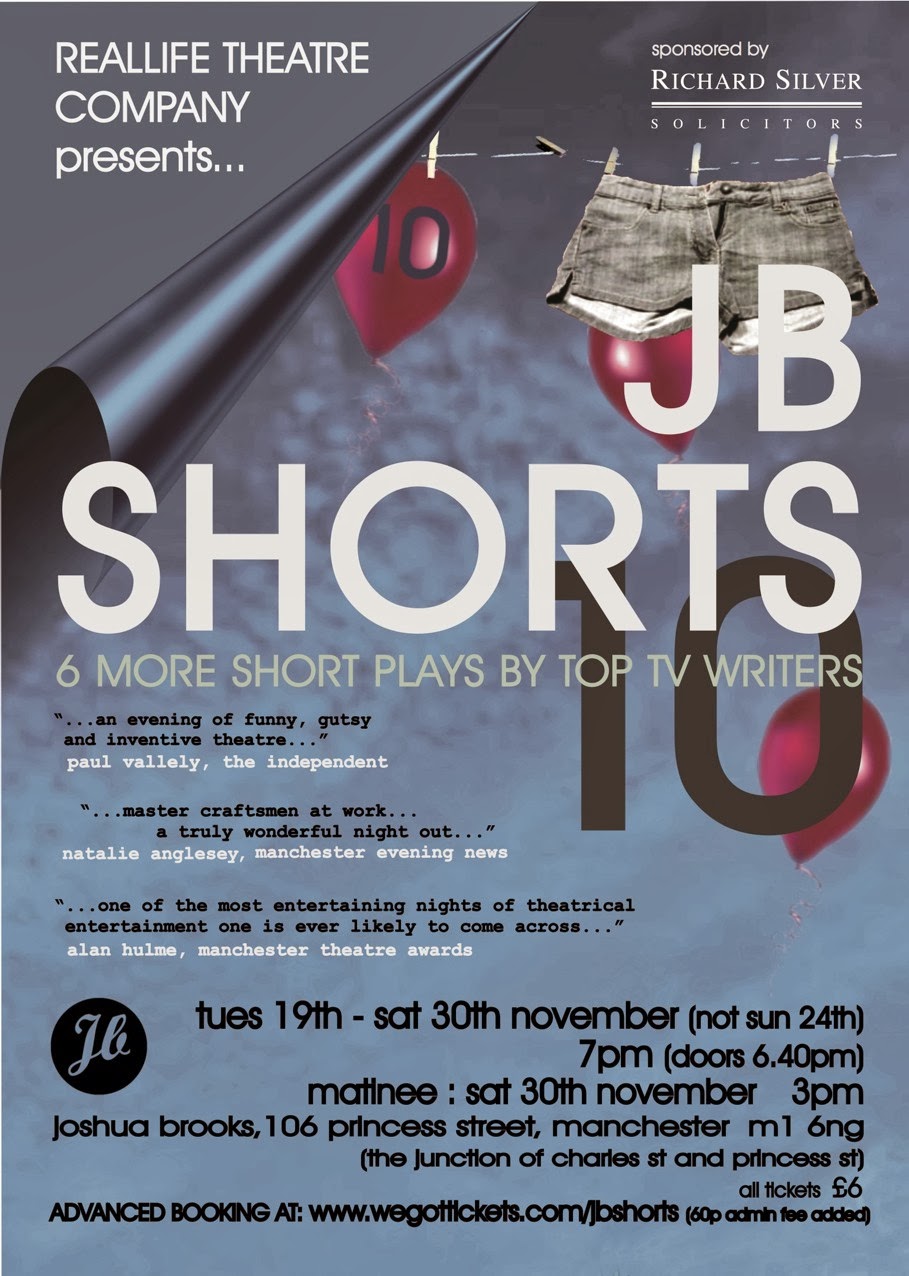
JB Shorts 10 @ Joshua Brooks, 26.11.13
A posing Mozart, a man playing Uncle Sam and a full-of-himself thespian all on one stage, on one night, can only mean one thing: JB Shorts is back. First off the thespian in What A Performance, featuring a bickering bunch preparing for a meaningless matinee. The directing had some nice touches and the dialogue was fun, even if the story itself was going over well-worn ground. Following in its footsteps came Big Game, which touched on some interesting ideas concerning body image and gender, but felt more like an essay on the subject rather than a conversation two people might actually have. Relationship counselling conundrum Relate also dealt with interesting issues, this time concerning sexuality. However, it felt like once the plot twist was revealed it had nowhere else to go... ...which takes us into the interval. And, to mirror the night, let me take a few moments to have an interval of my own and say a couple of words on the series itself. JB Shorts is always entertaining, but sometimes it feels like you’re seeing the same actors performing scripts by the same writers covering similar subjects. There’s always one piece about the theatre, another about a one-night stand and usually something involving therapy. JB Shorts 10 was no different, which is a shame since the supportive audience and short format make it ideal for experimentation. Anyway, back to the plays...
...after the break came Icarus Descending, whose plot concerned a possible meeting between Mozart and Beethoven. While not a bad idea in itself it didn't quite work on this occasion, perhaps because the references were a touch predictable. Then came the last two plays, which turned out to be by far the best. Penultimate performance A Special Relationship, written by James Quinn, was a humorous take on Anglo-American relations. Featuring a well concealed reveal, the script was full of funny one-liners and managed to be political without being preachy. Mention too should go to Rob Ward and Sarah McDonald Hughes, whose deliberately stereotyped characters (American and French respectively) were perfectly balanced on the border between satire and silliness. Following this was a welcome return for never-been-kissed couple Angela (Susan McArdle) and Andrew (Will Travis), in Blind Date 2. Last time out (Blind Date was performed at JB Shorts 9) ended in disappointment, but in the intervening months absence has made the heart grow fonder. The acting was spot on, the writing funny and caring, while the directing kept it all moving along at just the write pace and with plenty of feeling. A great end to another fun night out at JB Shorts. Words: Andrew Anderson Image: JB ShortsTuesday, 26 March 2013
JB Shorts 9
JB Shorts always provides an interesting mix-up of styles and approaches, and none more so than on this, its ninth outing. Although there is diversity in setting and mood among the plays, from police training and first dates to breakdowns and bonhomie, there are some common themes. Technology, and the frustration with it, comes up several times, as does the role of the writer; two of the six plays deal directly with the struggle of writing. But, as always in this short format, simple stories with emotional truths make for the best work.
Blind Date covers old ground – dating – in a way that makes it seem new. In this two-person play, writer Dave Simpson looks at dating for people with low self-esteem, who are trying to make the best of what they see as a bad hand. We already know that people exaggerate when they meet online, and that meeting someone new can be a stomach swirling experience, but the innocence and directness of the two characters cuts away preconceptions, and reveals the humanity behind looking for love. It deals with the topic in a humorous, but melancholic, way. Susan McArdale and Will Travis are funny and likeable as the two would-be lovers, while director Alice Bartlett makes use of some wonderful transitional scenes to hold it all together. A very good play, indeed.
Old, New, Borrowed And Blue is at the other end of the love spectrum, set moments before a wedding is due to take place. The main characters are two sisters, one of whom is about to get married, while the other thinks it is all a big mistake. They cover their family history and the trajectory of their lives as each tries to convert the other to her point of view. Samantha Power is excellent as the bride-to-be, dishing out some very intense glares and stares without being over the top. The play also manages to do something very tricky in 15 minutes, which is to have a twist that is not obvious yet not unexpected and, hardest of all, not contrived.
As alluded to already, two of the plays deal with the difficulties of being a writer and expressing yourself creatively. Are We Cool sends up late night review programs like Newsnight Review in a way that, while entertaining, does not cover new ground. The jokes of writer James Quinn gained the cast some of the biggest laughs of the night, but the play descends into farce for no good reason. In a similar vein, The Script plays on a fairly familiar idea that ‘luvvies’ end up destroying the thing they set out to create, namely by ignoring the writer. Again, the play is funny in parts, and very well performed, but it is too easy a target.
The remaining two plays struggle with the parameters of JB Shorts. 15 minutes is not a long time for a play, and the set and staging are inherently limited. Zeroes And Ones deals with a man having a temporary breakdown, and conveys the stress of family life very well, but some of the speeches about the evils of technology seem a bit sluggish, and there is simply not enough time to deal with so many conflicting and difficult issues. Baaji On The Beat, on the other hand, needs more focus and a more believable set up, as it quickly descends into silliness.
As ever, some moments are brighter than others, but the overall quality of the six 15 minute plays is excellent, and JB Shorts continues to be something to look forward to in the theatre calendar.
Words: Andrew Anderson.
Images: courtesy of Joshua Brooks.