Showing posts with label manchester international festival. Show all posts

Monday, 13 July 2015

MIF: Arvo Pärt @ Bridgewater Hall, 12.07.15

Arvo Pärt’s compositions are the most performed of any living composer in the world, but his music grows seemingly from the very birth of music itself. Drawing on deeply spiritual and contemplative themes, his Gregorian chant-inspired vocal and string repertoire transcends the present tense and has not only won him the highest of accolades from the most educated of music listeners, it has also touched a vast, perhaps less-discerning audience searching for serenity and purity, found in his accessible musical vocabulary.


Performed tonight by the Manchester Camerata under the direction of Gábor Takács-Nagy, alongside long-time Pärt collaborators Vox Clamantis, an Estonian choir, the eloquently selected programme is allowed to resonate and shine in the presence of Pärt himself. ‘Drei Hirtenkinder aus Fátima’ is a new composition dedicated to MIF collaborator Gerhard Richter. This short vocal piece is inspired by a visit to Fatima in Portugal, the site of a Marian apparition of the Virgin Mary in 1917, in which she is said to have appeared to three shepherd children and prophesied the Second World War. However, Pärt focuses on the light and joy of the children, relayed by the eloquent, bouncing “hallelujahs”.

‘Fratres’, translated as ‘brothers’, follows a repeated six-bar string theme with an unerring flow, countered by a striking percussive interlude on claves and bass drum, both directly cutting and billowing at once. Opening with a sublime stillness and a grounded bass drone, the piece hesitantly repeats, growing into itself, reaching grandeur of strings in full flow before retreating back into its subdued self.


Pärt’s ‘Stabat Mater’, a medieval poem based on the sufferings of Mary, Jesus’ mother, during his crucifixion, seems only too perfect a subject for his music. The serene start develops into an almost conversational interplay between the strings and choir before bursts of frantic and expansive energy portraying her intense pain disappear as soon as they’ve developed. This, along with most of this evening’s events, are seemingly relentlessly disrupted by sporadic coughing from the audience as if the plague has fallen upon Manchester, perhaps nervous interruptions from an audience not used to such extensive stillness and reflection. The death of this drawn-out sorrowful suffering (Mary, not the coughing) is preceded by what could be considered two last gasps for breath, for which the audience can only withhold theirs, before the final chord slips away into silence.

‘Da Pacem Domine’, written in memory of the 2004 Madrid bombing victims, is a prayer for peace and is now performed annually in Spain. Setting text from a sixth century hymn, its almost plea-like nature is accentuated through the withheld melodic progression.


To close, ‘Como Cierva Sedienta’, featuring soprano soloist Polina Pasztircsák and a full orchestra, offers a setting of Psalms 42 and 43 in Spanish. Its exploratory nature is in great contrast to much of tonight’s programme, flitting between frantic woodwind flurries, brass fanfare and Stravinsky-esque modernist dissonance. But it does retain some of the serene moments that we are used to hearing from Pärt, and like each of his pieces, without doubt, every note matters. Each has been carefully considered by Pärt and the performers have no choice but to follow suit. Don’t be fooled by the apparent simplicity of his music, the concentration and detailed execution required from each performer in creating such tonal, textural and sonorous eloquence cannot be underestimated. Perhaps it’s this which aids the seemingly infinite power of his music. His ability to create such seemingly simple soundscapes through complex fundamental historic compositional techniques, often foregoing generations of music history, allows Pärt to transport the listener to a place of deep spiritual contemplation and that much closer to purity.

Words & photos: Simon Bray (@simonbray / simonbray.co.uk)

MIF: Neck of the Woods @ HOME, 10.07.15

Who’s afraid of the big bad wolf? Certainly not me in the MIF production of Neck of the Woods. There were far worse things to fear. If you go down to the woods today, you will be leaving underwhelmed.

On paper, this ‘collaboration’ ticks all the boxes and garners expectations of something special. An acclaimed casting choice (Charlotte Rampling), check. A concert pianist (Hélène Grimaud) playing a phenomenal repertoire, check. An eclectic and culturally diverse choir using their voices to create the soundscape, check. A new multi-million pound venue to host the event, check. And all under the reign of a Turner Prize-winning visual artist (Douglas Gordon) – big check. But, heartbreakingly, no. In fact, there was barely any collaboration, and these components struggled to come together resulting in something fractured and unconnected, which is a real shame.


Neck of the Woods is a vague retelling of Little Red Riding Hood, while drawing on the many different takes of wolf mythology in literature and a very loose metaphor of the animal of man. “Mostly wolves represent a bad man […] I think men are worse than wolves,” says Gordon.

The play opens in complete darkness with the sound of a tree being chopped down with an inevitable crash. This is probably the most impressive part of the production and, with the almighty sound, the audience is immediately immersed. The HOME acoustics are so good that it was truly terrifying.

The production is hugely self-indulgent, with Gordon listed in the programme for concept, direction, design and performance. None of which met par. That’s not completely fair, the concept is very interesting and I think there is something there. As for everything else, I felt it was very safe and riddled with clichés. There’s talk about blood, wolves and snow, so you can bet there was red lighting, fake snow and a fluffy shag pile with a wolf head.


This project clearly hosted a lot of talent. Grimaud’s playing is a beautiful silver lining to this piece. The Sacred Sounds Women’s Choir, first formed at MIF 2013, is abundantly talented, but drastically underused in this production. Rampling did have a few fluffs, but overall I felt she didn’t have much to work with, which I imagine is quite restrictive.

Regrettably this piece hasn’t met the standard set by other MIF productions, the responsibility for which falls on Douglas as he struggles to harness the hot ball of talent he had at his disposal and utilise it effectively. Instead, he rides on the coattails of other people’s talent and uses it for his own gratification. Douglas is indeed the wolf, and a house of straw or sticks has more solidity than this piece.

Words: Kate Morris

Neck of the Woods continues until Saturday 18 July. For tickets and more info, click here.

Friday, 10 July 2015

MIF Acoustic Stage @ Albert Sq, 04.07.15

The denizens of Manchester are enjoying these weekend festivals. Following the popularity of Manchester Day, it’s no surprise to find that Albert Square was thronged for the opening weekend of Manchester International Festival.


In glorious sunshine illuminating the festival tent, balcony bar and acoustic stage, it's not just the food stallholders and ice-cream sellers who have smiles on their faces.

Throw in four sets of musicians to perform from early afternoon to evening and it all added to the relaxed atmosphere that people savour. The downside for a musician is that an open-air arena, with young children freely running around and taking advantage of the kid friendly area, is not the best location to demonstrate the quality of your works. Mix that with the background chatter and the performers are relegated to the level of sideshows.


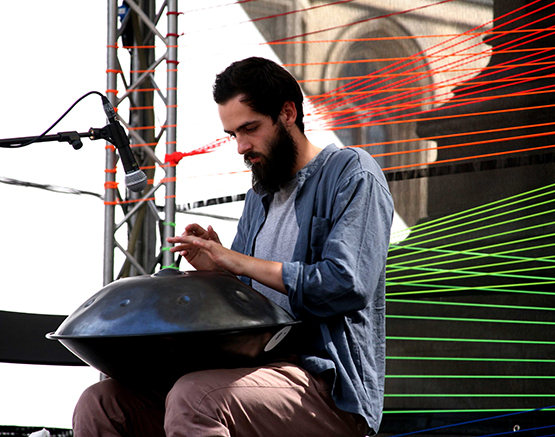
Playing an instrument called the handpan, Matthew Bailey eschews vocals to focus on comfortable, percussive sounds that match well with the atmosphere. To the untrained eye, the instrument looks like two distorted cymbals taped back to back, but the sounds are languid and fluid.


Charlie Cooper appears in different guises, both as a solo artist or part of a band, and for this afternoon event she was supported by Rachel Lasham on drums. It turns out be a wise choice that provides substance to support Cooper’s keyboards which could have otherwise rapidly floated away in the warm air.

Josephine, minus her surname Oniyama, is well-known and respected amongst the music followers in the northwest area, but when it comes to competing with the chimes of the town hall clock, first at 6pm then 7pm, even she will come off second best. The first time she used the interruption to signal the start of her set, but the second time, occurring mid-song, pretty much destroyed the effects of her stories.


Still, it’s a positive move to promote local talent of varying styles, and the approach will be replicated during the remainder of the festival at its Albert Square base.

Words & photos: Ged Camera


The Festival Square Acoustic Stage schedule continues until Sunday 19 July.

The Invisible Dot Cabaret @ MIF, 09.07.15

The Invisible Dot have been tasked with bringing comedy to MIF for the first time, and while it may be moaned about that they have predominantly invited acts who’re based outside of Manchester, they have served up a winning piece of late night entertainment. The line-ups will change throughout the cabaret’s run, but if they keep up this high calibre, you're guaranteed some late night laughs. In true cabaret style, they present us with a variety of comedic forms and the mix works well.

Neurosis seemed to be the theme of the night as compère for the evening Mae Martin shared jokes about worried mothers and the emotional anguish brought on by Brian Cox. A Canadian, Martin had good fun with English accents, but needs to worry less about whether we have seen things over here. Relaxed and playful, she kept the evening ticking over nicely.


Phil Ellis (the only local on the bill) always thrives off the audience, his energetic performance dragging us helplessly along in his wake. He's easily distracted by new ideas and, although a veer towards darker material at the end of his set threatens to derail the audience's goodwill, Ellis makes for a great opener.

Natasha Demetriou and Ellie White followed as the Sexy Dangerous American Girl Cousins. There were some lovely lines and it's a very physical performance, but ultimately the characters came off a little one-note for me, and the intentionally “so bad it's good” finale didn't quite land.

The night was rounded off by Sheeps, a sketch trio who play with and deconstruct the sketch form in smart, but rarely too-clever-for-their-own-good ways. It took them a moment to kick into gear, but soon had the audience following them with every twist and turn. Sketch topics veered from a preview of their new musical based on Oliver Twist (“We've spotted a gap in the market”) to a violent ruckus between Chuckle Brothers via cat-based whimsy. A great way to close the night.

The 90-minute show flew by without an interval and proved to be a great night in all, but, although the Invisible Dot has a roster of excellent comedians, perhaps next year we can show off more home-grown talent instead of relegating it to the fringes. Hopefully next year the comedy offering will grow and we will see even greater and braver variety.

Words: Sean Mason

The Invisible Dot continues each night until 17 July. For more info and tickets, visit its MIF web page.

Thursday, 18 July 2013

Massive Attack v Adam Curtis @ Mayfield Depot, 13.07.13

Billed and very heavily marketed as one of the leading events of Manchester International Festival, Massive Attack v Adam Curtis is described as neither a film nor a gig but rather, and this is the portmanteau of Adam Curtis himself, as a ‘Gilm’. It could equally well be described as a ‘Fig’ but I guess that was decided against as the word was already spoken for.


Massive Attack have long had a reputation as the masters of dark, brooding melancholy of post-industrial trip-hop so any collaboration between Robert del Naja and Adam Curtis, the film maker responsible for the highly acclaimed Power of Nightmares, is going to be met with a great deal of excited anticipation. The show promised to be a utilisation of film, music, ideas and imagery, and on this point it undoubtedly succeeds. What those ideas are though, I’m not quite sure.

Surrounded by three walls of giant screens which project images while Massive Attack play from behind one of them, the event begins with old film of a 1970s Siberian disco to the strains of ‘Rock The Boat’ and diving into a world of imagery that contrasts the ordinary people of Chernobyl as true revolutionary heroes to the concept of a managed world, controlled by banks and the powerful elite, and Jane Fonda exchanging principles of socialism for the high profit of body fascism. Veering between moments of Oh, that was interesting to Yeah, so what? the whole experience comes across as a bit of a sixth form politics student idea of how the world is and how we should see it set to a very expensive PowerPoint presentation. The music though, from Horace Andy singing ‘Sugar Sugar’ and the exquisite voice of Liz Fraser of the Cocteau Twins doing Burt Bacharach, through to Nirvana and yes, I’ll admit it, a cracking version of Sugababes’ ‘Push The Button’, is faultless.


Adam Curtis is the acceptable face of propagandist filmmaking. His talent for persuasion is beyond doubt and his use of montage to make a point is up there with the greatest of cinematic propagandists, such as Sergei Eisenstein and Leni Riefenstahl. I make the comparison not because I believe the three are ideological bedfellows but simply because of their undoubted power to persuade. Curtis differs from the other two because he is profoundly anti-establishment and on the face of it he carries no particular political allegiance although clearly he is anti-capitalism. Adam Curtis appears to be anti lots of things but like most polemicists he never gets round to saying quite what he is actually for.

Through his films Curtis asks questions of the audience, makes his cinematic statements and representations and invites them to draw their own conclusions. That’s all well and good but, having said that, he does tend to punch you in the face with his cherry-picked moments from contemporary history and the overall narrative, while undoubtedly powerful, is often confusing. As a sensory spectacle and a piece of performance art it is unquestionably impressive. As a work of anything of intellectual substance it is as opaque as the screens that separate the band from the audience.


The use of the long abandoned Mayfield Depot as the location is another MIF masterstroke of venue specific choices for their key artistic events. Derelict since 1986, the interior evokes the death of industrialisation in the world’s first industrial city. At the end of the event the audience is led out through the cavernous depot, scanned by searchlight and watched over by guards with German Shepherds barking threateningly. The message is clear – you are being watched. You are being managed. Yet the future is unwritten and it is yours for the taking.

Well, yes, maybe it is. But for now, on this hot night in the middle of summer, everybody seems to be going onto somewhere else, unmanaged and in charge of their own future, to bars, clubs and parties.

We’ll start the revolution tomorrow. Maybe the day after. We’ll see.

Words: Robert Pegg.
Photography: James Medcraft.

Tuesday, 16 July 2013

The Masque of Anarchy @ Albert Hall, 13.07.13

The tradition of Mancunian dissent is a long and noble one (see Now Then Manchester Issue 3). At the heart of that tradition are the events of 16 August 1819 when thousands gathered on a site that was once the Free Trade Hall – and is now the rather more prosaically and uninspiringly named Radisson Blu Hotel – to hear orator Henry Hunt speak in favour of parliamentary reform. The meeting was broken up on the orders of the local magistrates and following the unprovoked cavalry charge 15 lay dead and over 600 wounded. The red plaque on the front of the once proud building bears testament to this.


The semi-refurbished Albert Hall on Peter Street, yards away from the original site of what rapidly became known as The Peterloo Massacre, is an inspired choice of venue for a performance of Shelley’s brilliant polemical poem. It was originally written in the white heat of anger once news of the carnage reached him in Italy and is now being brought to life as one of the highlights of the Manchester International Festival.

As you walk upstairs and into the faded baroque, gothic elegance of the old Methodist Hall, you wonder what John Wesley would have made of this, as founding father of temperate Methodism and a dissenter at heart and in whose name the upstairs chapel and public meeting place was built. Or Shelley, himself, permanently expelled from Oxford University eight years earlier for refusing to retract his essay ‘The Necessity of Atheism’. I think both would have been quietly proud of the meeting of the sacred and the profane for the performance of this secular masterpiece.


Maxine Peake takes the stage carrying a night light and places it in front of a thousand candles which form the main part of the stage lighting. Dressed in a plain white commoners’ dress, symbolic of the purity of the noble ideals of the day, she begins to address the audience. Part sermon and part call to arms, each perfectly enunciated word is delivered, intonation rising and falling with each verse. Even the oppressive heat and the fading light of a Friday evening in Manchester seen through the stained glass of the chapel play their part and as each verse is delivered a giant shadow is cast behind Peake, not just as the ghost of the 15 dead of Peterloo but as a glorious angel of protest watching over dissenters through the ages.

Everything about this event is perfect. The subject matter, the venue and location, the staging and lighting and above all the performance of Maxine Peake. If the oratory of Henry Hunt was to be this powerful and persuasive then it is no wonder the authorities of the day had reason to fear his influence.

The Masque of Anarchy. A love poem for the dispossessed.

Words: Robert Pegg.
Photography: Kevin Cummins.

Saturday, 6 July 2013

The Old Woman @ Palace Theatre, 05.07.13

I don’t even pretend to know anything about absurdist theatre, least of all Russian absurdist theatre and to try to convince you that I do would be, well, absurd.

But I think I understand three things about absurdist theatre in general and Russian absurdist theatre in particular, and those three things are: one, I don’t understand it; two, I don’t think anybody else does and if they say they do, they’re probably lying; and three, neither of the first two things matter. Remember these three things and you may begin to make sense of The Old Woman. Or not. It doesn’t matter.


Daniil Kharms was born in St Petersburg in 1905 and came of age in the last days of revolutionary optimism before Bolshevik violence took a stranglehold on the arts. First arrested in 1931 when the avant garde was criminalised, he began to write children’s literature and buried himself in the absurd and the surreal. Arrested again for treason in 1941, he died a year later aged 36, probably of starvation in what was then Leningrad, with most of his work remaining unpublished until the Gorbachev era of Glasnost.

As part of Manchester International Festival, Darryl Pinckney’s adaptation of Kharms’ novella The Old Woman stars Mikhail Baryshnikov and Willem Dafoe as characters simply called A and B. It matters not which is which but it makes it much easier to understand once you realise they are one and the same person, or rather two aspects of the same imagination of the character, The Writer.


The old woman of the title exists only in the imagination of the writer, which is also important to remember.

She holds a clock that has no hands yet still she tells the writer the time. He goes home to work on a story and the old woman follows him, orders him around, sits in his chair and dies. The writer hates corpses; not as much as he hates children, but he hates them nonetheless. He goes to buy vodka and bread and all the time he is accompanied by himself, his friend and narrating to himself. The writer meets a young woman but he cannot take her home because of the dead old woman and when he finally returns he finds the old woman not dead but crawling around. He wants to kill her and has nightmares about her murder. He puts the old woman into a suitcase and gets on a train where the suitcase disappears. An old woman holds a clock that has no hands. The writer asks for the time. The old woman tells him the time.


Bringing this bizarre and captivating tale to life are Baryshnikov and Dafoe. To watch Baryshnikov move across any stage is worth the ticket price alone but to see him partnered, step for gentle step, in this surrealist danse macabre by Willem Dafoe is dual performance just too good to be missed. Complementing each other perfectly as essentially one and the same character, yet maintaining individuality, each exquisitely choreographed movement is executed with a precision that matches the snappy, camera shutter, blink-of-an-eye scene changes.

Vigorously directed by renowned avant garde director Robert Wilson, this extraordinary fable is played out in what appeared to me to be something reminiscent of German Expressionism by way of jazz age, vaudeville, pierrot slapstick and Waltzing Matilda.


To me, The Old Woman is about a writer struggling for an idea. Locked out of reality and into his stark and terrifying imagination where random thoughts wander off and take on a life of their own, repeating themselves over and over and over again. Nothing makes sense and the unconsciousness and schizophrenic mind, portrayed by Baryshnikov and Dafoe, is at once alarming, bleak, humorous and paranoid. To anyone else, it would probably be something entirely different and if absurdism has any kind of point at all then the point is that it can mean as much or as little as you want it to.

The Old Woman is the work of a darkly mad soul full of imagination, inventiveness, surreal energy, comedy and fantastic invention. None of it makes sense because nothing in it is real but once you accept that nothing is real, that life is meaningless and nothing matters, then you begin to get it and once you begin to get it and allow yourself to be drawn into the fragmented helplessness of the beautiful and tortured mind of Daniil Kharms, then prepare to be astonished.

Words: Robert Pegg
Images: Lucie Jansch, courtesy of MIF

The Old Woman is being performed as part of Manchester International Festival and continues at the Palace Theatre until 7 July.